

Duowei Electric: Your Leading BLDC Motor Driver Supplier
Changzhou Duowei Electric Co., Ltd. was founded in 1997 and has more than 200 employees. It has developed hundreds of different product applications and established extensive strategic partnerships around the world.
Why Choose Us?
Wide Range of Applications
Our products can be used in various industries including automotive, industrial automation, robotics, household equipment, medical equipment, HVAC systems, office equipment, defense and aerospace, electrical equipment, and power tools.
Professional Services
We can provide customers with "customized services" to meet their long-term needs through tailor-made products. At the same time, we have more than 20 years of production experience and can provide large-scale electric motor production services.
Quality Assurance
ZWS series brushless DC motors, HC series motors, and YY series induction motors have passed UL certification. HC series motors, YY series induction motors, and YDK series air-conditioning motors have passed 3C certification and obtained "Export Product Quality License"
Mass Production of Various Motors
We have realized mass production of 57ZWS, 83ZWS, 120ZWS brushless DC motors. Besides, the linear motor was also successfully developed and put into mass production.
-

48V 1500W BLDC Motor Controller
48V 1500W BLDC Motor Controller is a closed-loop speed controller, which uses IGBT and MOS power,uses hall signal of the DC brushless motor to perform double-loop speed control, and has a PID speed Add to Inquiry -
Brushless DC Motor Electronic
Brushless DC Motor Electronic mainly uses high-performance special brushless DC motor driver chip, which has high integration and small size. A series of advantages such as perfect protection, simple Add to Inquiry -
48V 750W BLDC Motor Controller
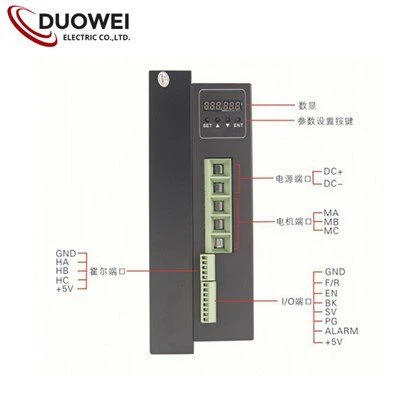
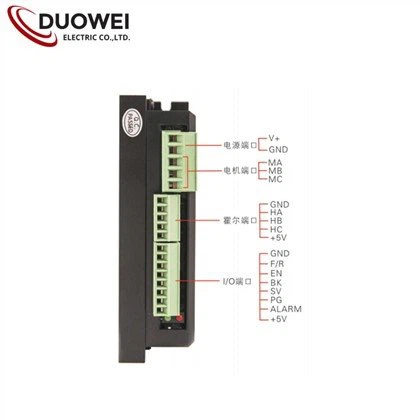
48V 750W BLDC Motor Controller is a small power driver independently developed for the modern industrial automatic control field. This driver is suitable for driving small and medium-sized brushless Add to Inquiry


Definition of BLDC Motor Driver
The self-controlled variable frequency drive employing a sinusoidal PMAC (Permanent Magnet Alternating Current) motor is called brushless DC motor driver or BLDC motor controller. The brushless DC motor driver has some advantages like practically they require no maintenance and have a long life. They also have low frequency, low inertia and friction, and low radio frequency interference and noise. The only disadvantage of the drive is that they have high costs and low starting torque.
Working Principle of BLDC Motor Driver
A BLDC motor driver switches the current using transistors of a half-H bridge circuit. The number of transistors depends on the number of phases or windings energized by the controller. A 3 phase brushless DC motor controller (one of the most common configurations) requires three half-H bridges, that is one high-side and one low-side switch for each phase. Upon receiving MCU signals, the gate drivers open the transistors and supply the current to the stator’s windings. To switch between the phases, the controller needs to know the position of the rotor. There are two ways to detect it: install a position sensor and use its measurements; sense back electromotive force (back EMF) that arises in the stator’s windings together with the rotor’s motion.
Benefits of BLDC Motor Driver
Make Motors Spin Simple
BLDC motor drivers make spinning BLDC motors as simple as possible by reducing design complexity while improving system efficiency.
Higher Power Density
BLDC motor drivers often have a higher power-to-weight ratio, making them suitable for applications where space and weight are critical factors.
Precise Speed Control
BLDC motor drivers enable more precise and responsive speed control through electronic commutation, allowing for smoother operation across varying loads.
Quieter Operation
The elimination of brushes and the resulting friction allows for quieter operation, making BLDC motor drivers ideal for noise-sensitive applications.
Adaptability to Advanced Control Systems
BLDC motor drivers can be easily integrated into advanced control systems, enabling more sophisticated and customized operations.
Extended Lifespan
The absence of brushes and the resulting reduction in wear contribute to a longer lifespan for BLDC motor drivers, especially in continuous or high-demand applications.
Types of BLDC Motor Driver

1. Sensored BLDC Motor Controller(Driver)
Sensored BLDC motor controllers are the most common type of motor controller used in BLDC motors. They rely on feedback from sensors that sense the position of the rotor. Typically, the rotor’s magnetic field is detected using Hall effect sensors. Then, the controller uses the information from the sensors to determine the correct timing for the electronic switches that control the motor. One advantage of using sensored BLDC motor controllers is that they provide accurate position information, which can control the motor’s speed and torque more precisely. They also offer better performance at low speeds and smoother operation at all speeds. However, they are more expensive than sensorless controllers and require additional wiring and components.
2. Sensorless BLDC Motor Controller(Driver)
Sensorless BLDC motor controllers aim to operate without feedback from sensors. Instead, they use a technique called back-EMF sensing to detect the position of the rotor. Back-EMF is the voltage generated when the rotor moves through the stator’s magnetic field. The voltage is related to how fast the motor goes, so it can use to determine where the rotor is. These controllers are less expensive than sensored controllers and require fewer components. They are also more effortless to install and demand less wiring. However, there are chances that they may not provide as precise speed and torque control as sensored controllers. They also have lower performance at low speeds and may experience more vibration and noise.
3. Field-Oriented Control (FOC) BLDC Motor Controller(Driver)
Field-oriented control (FOC) BLDC motor controllers are sensored controllers that use a mathematical model to control the motor’s speed and torque. First, FOC controllers use information from the sensors to determine the status of the rotor. Then they use a mathematical model to calculate the appropriate voltage and current to apply to the motor. As a result, FOC controllers perform better than others and get used in high-performance applications such as electric vehicles. FOC controllers have several advantages over other types of controllers. They provide accurate speed and torque control, remarkable efficiency, and reduced vibration and noise levels. They can also control the motor in both directions and be programmed to provide different performance profiles. However, FOC controllers are more complex than others and require more advanced programming and tuning.
4. Sinusoidal BLDC Motor Controller(Driver)
Sinusoidal BLDC motor controllers are FOC controllers that use sinusoidal waveforms to control the motor’s speed and torque. Sinusoidal controllers use a sinusoidal waveform to maintain the current and voltage applied to the motor. The waveform is synchronized with the rotor’s position and provides smooth, efficient operation. Sinusoidal controllers provide several advantages over other types of controllers. They provide accurate speed and torque control, excellent efficiency, and reduced vibration and noise levels. They also provide smoother operation than other controllers and are commonly used in high-performance applications such as electric vehicles and robotics.
5. Trapezoidal BLDC Motor Controller(Driver)
Trapezoidal BLDC motor controllers are sensorless controllers that use a trapezoidal waveform to control the motor’s speed and torque. Trapezoidal controllers use a waveform synchronized with the rotor’s position, providing smooth and efficient operation. Trapezoidal controllers are less expensive than other controllers and require fewer components. They are also more effortless to install and demand less wiring. However, they may not provide as precise speed and torque control as sensored controllers. Issues related to lower performance at low speeds can also be faced.
6. Hybrid BLDC Motor Controller(Driver)
Hybrid BLDC motor controllers are a type of controller that combines the features of sensored and sensor-less controllers. Hybrid controllers use sensors to detect the position of the rotor at low speeds and then switch to sensorless operation at higher speeds. It allows the controller to provide accurate position information at low speeds and high efficiency at high speeds. Hybrid controllers provide several advantages over other types of controllers. They provide accurate speed and torque control, excellent efficiency, and reduced vibration and noise levels. They also provide better performance at low speeds than sensorless controllers and are less expensive than full-featured sensored controllers.
Applications of BLDC Motor Driver
Industrial Automation
In industrial automation, the use of BLDC motor drivers has become increasingly common due to their efficiency, reliability, and precise control over motor speed and torque.
Electric Vehicles
The use of BLDC motor driver in electric vehicles is essential to ensure the vehicle’s efficient and reliable operation. They are used in electric vehicles such as electric cars, electric bikes, and electric scooters. The drivers regulate the motor’s speed and torque to ensure efficient power consumption and smooth operation. The driver helps to enhance the vehicle’s performance, expand its range, and prolong its life by being able to precisely control the motor’s speed and torque, enable regenerative braking, manage the battery’s performance, and protect the motor.
Robotics
BLDC motor drivers are widely used in robotics applications. Here the BLDC motor driver plays a crucial role because it provides precise and accurate control over the motor speed and torque. It is essential as it ensures efficient power consumption, smooth operation, and precise motion control which is the base of its functionality.
HVAC Systems
In HVAC (Heating, Ventilation, and Air Conditioning) systems, BLDC Motor drivers play a major role when it comes to controlling the speed of the motor that drives the air handler or the fan. It is also essential to reduce energy consumption and increase the system’s efficiency.
Medical Devices
BLDC motor drivers are used in a number of medical devices like surgical tools, medical pumps, and medical imaging systems due to their high efficiency, reliability, and accuracy. They are responsible for providing precise and controlled motion for devices that require high accuracy, speed, and safety.
Consumer Electronics
BLDC motor drivers are used in various types of consumer electronics applications like power tools, electric shavers, and cooling fans. They are highly preferred in consumer electronic businesses due to their high efficiency, low noise, and long lifespan. It is important to have reliable and efficient control over the motor speed to operate these applications.
Circuit Design of BLDC Motor Driver
A typical BLDC motor controller(driver) has a half-bridge or half-H bridge circuit. Unlike an H bridge, this circuit configuration has only two switches - one high-side and one low-side transistor. Most brushless motors use two or three-phase power systems. So in a BLDC motor controller circuit diagram, this will look like two or three half-bridges (depending on the number of phases) with a pair of switches each. Let's take a closer look at a 3 phase brushless DC motor controller with Hall-effect sensors to view the basic principles of its circuit design.
The stator has three-phase windings located at 120° to one another. Each winding has a vector representation of voltage and current applied to the stator. The BLDC motor controller Hall sensors identify the rotor's position. Upon receiving the sensor data, the power MOSFETs switch the current, injecting it into the right winding. In a high power brushless DC motor controller, IGBTs and GaN switches can replace MOSFETs. Either integrated or discrete gate drivers can control the transistors. The drivers of a brushless motor controller schematic act as intermediaries between the switches and a microcontroller (MCU).
The three-phase BLDC motor controller circuit includes six steps necessary to complete a full switching cycle (that is to energize all the three windings of the stator). By turning the high-side and low-side transistors on and off, the current flows through the stator windings in sequence. When designing a BLDC motor controller, engineers can use different current switching, including trapezoidal and sinusoidal commutation. The names relate to the signal waveforms. The trapezoidal commutation allows two windings out of three to stay energized simultaneously. In the sinusoidal approach, the phase shift complies with the law of sines, so current switching between the phases becomes smoother. The trapezoidal method is simpler, but at low speeds, it tends to cause vibration in the motor. The sinusoidal commutation, on the other hand, becomes challenging at high speeds. Typically, a sinusoidal brushless motor controller circuit uses pulse-width modulation (PWM). It helps regulate the current injected into the rotor's windings and run the commutation process more smoothly and efficiently. This applies especially to closed-loop controllers that get feedback on the output signal and adjust the input power by varying the duty cycle. A duty cycle is the percentage between the current pulse and the complete cycle of the current signal.
A BLDC motor speed controller changes PWM duty cycles to create sinusoidal signals. PWM switching frequency can be different for various applications. Although it should be high enough to prevent power loss. The physical limitations of the stator determine the maximum frequency level. However, there are also the specifications of the control unit itself. So even if the stator allows you to increase the PWM frequency, you will not be able to do that because of the limited capabilities of your DC brushless motor controller.
As an option, you can employ hysteresis to control the operation of a BLDC motor. This method relates to the sinusoidal commutation too. It allows you to establish the upper and lower limits of the current supplied to the motor. As soon as the current reaches its upper or lower range, the transistor switches turn off or on respectively and change the average current using the law of sines. You can implement a BLDC motor controller half-bridge as either an integrated circuit (IC) or as discrete components.
Maintenance Tips for BLDC Motor Driver
Overheat Protection
When the brushless DC motor driver runs for a long time in excess of its rated current under overload fault, it will cause the motor to overheat and reduce insulation. The protector calculates the heat capacity of the brushless DC electric motor driver according to the heating characteristics of the motor driver, and simulates the heating characteristics of the motor to protect the motor. The characteristics of overload protection correspond to different trip levels.
Blocking Protection
When the high speed brushless DC motor driver is starting or running, if the electric timing shaft is stuck due to excessive load or its own mechanical reasons and the fault is not removed in time, the motor driver will be overheated, the insulation will be reduced and the motor will be burned down. Lock-turn protection is suitable for permanent magnet DC motor driver starting to protect such faults. Blocking protection is applicable to protect the driver when such faults occur in the process of operation. When the current reaches the set current of action, the protector should act within the set time of action or alarm time.
Maintenance of Commutator
Commutator is a very important part of brushless DC motor driver, which is also one of the main reasons for motor failure. Among them is the commutator this piece, commutator working condition is directly related to the DC motor driver working condition, so must strengthen maintenance. The main fault of the commutator is the commutator spark. In order to make the motor driver run normally, we must keep the surface of the commutator clean and clean regularly. If the commutator surface of the brushless DC motor driver has slight stripes or grooves. The commutator can be polished or ground, and then clean silk cloth is used to wipe the surface of the commutator, which is conducive to forming an oxide film to protect the commutator.
Maintenance of Bearing
The maintenance and lubrication of bearings are generally determined according to the bearing speed, working temperature, working environment, etc. Generally, it is necessary to use bamboo pieces to scrape the grease inside the bearing of small brushless DC motor driver, and use low pressure steam for preliminary cleaning, because there will be old oil or some other debris inside the bearing sheet for a long time. In addition, it is also necessary to check whether the bearing inner and outer rings have running rings. In addition, it is also necessary to often measure the bearing clearance of the high power brushless DC motor driver to check whether the bearing has cracks, rust and discolor, etc. It can also rotate the bearing of the brushless DC motor driver to be smooth and sound uniform, without jam phenomenon.
Factors to Consider When Selecting BLDC Motor Driver

Determine Your Motor’s Electrical Requirements.
The first step in selecting a controller for your BLDC motor is to determine your motor's electrical requirements; this includes the motor's rated voltage, current, and power rating. You can typically find this information on the motor's datasheet, but it can also be found by using a multimeter to measure the motor's electrical characteristics. The controller you choose must be capable of handling the motor's voltage and current ratings.

Consider Your Control Requirements
The next step in choosing a controller is to consider your specific control requirements. Examples include the type of control method you want to use (sensor-based or sensorless), the required resolution of motor speed control, and the communication interface with your control system. Keep in mind that BLDC motor controllers support multiple control methods and communication interfaces, so make sure you select one that meets your specific requirements.

Evaluate the Controller's Performance Characteristics
Once you have determined your motor's electrical and control requirements, it's time to evaluate the performance characteristics of the motor controller. Some key performance parameters to consider include:
● Maximum Current and Voltage Ratings. The motor controller must be capable of handling the peak current and voltage requirements of the motor.
● Operating Frequency Range. The operating frequency range of the motor controller should match the requirements of your application.
● Efficiency. Look for a motor controller with high efficiency to minimize power losses and improve overall system performance.
● Protection Features. Consider motor controllers with built-in protection features such as overcurrent protection, overvoltage protection, and overtemperature protection to prevent damage to the motor and controller.
● Thermal Management. Choose a motor controller with proper thermal management features to ensure reliable operation under high-temperature conditions.
Certifications


Our Factory
Changzhou Duowei Electric Co.,Ltd. was founded in 1997 and has more than 200 employees. It has developed hundreds of different product applications and established extensive strategic partnerships around the world with these products. Duowei Electric, the manufacturer of Wit Motors, our company does not use "conflict minerals", and the broad service industries include: automotive, industrial automation, robotics, household equipment, medical equipment, HVAC systems, office equipment, defense and aerospace, Electrical equipment and power tools.
Ultimate FAQ Guide to BLDC Motor Driver
Q: How does a BLDC motor driver differ from a brushed motor driver?
A: Unlike brushed motor drivers, BLDC motor drivers use electronic commutation instead of brushes and a commutator, leading to improved efficiency and reduced maintenance.
Q: What are the main advantages of using a BLDC motor driver?
A: The main advantages include enhanced efficiency, lower maintenance, higher power density, improved reliability, precise speed control, reduced EMI, extended lifespan, quieter operation, adaptability to advanced control systems, and environmental considerations.
Q: Are BLDC motor driver suitable for applications with space and weight constraints?
A: Yes, BLDC motor drivers often have a higher power-to-weight ratio, making them well-suited for applications where space and weight are critical factors.
Q: How is speed control achieved in BLDC motor drivers?
A: Speed control is achieved through electronic commutation, allowing for precise and responsive adjustments to the motor's speed across varying loads. In a brushless DC motor driver, the relationship between the applied voltage and the load torque determines the rotational speed. This means that, when using the motor, you can control the rotational speed of the motor by changing the applied voltage.
Q: Do BLDC motor drivers require regular maintenance?
A: Yes, but BLDC motor drivers have fewer components prone to wear, resulting in lower maintenance requirements compared to brushed motors.
Q: Are BLDC motor drivers more reliable than brushed motor drivers?
A: Yes, the elimination of brushes reduces the likelihood of sparking and wear-related failures, contributing to increased reliability and smoother operation.
Q: Can BLDC motor drivers be integrated into advanced control systems?
A: Yes, BLDC motor drivers can be easily integrated into advanced control systems, allowing for more sophisticated and customized motor operations. As a bonus, a BLDC motor controller can be electronically controlled without the need for direct motion feedback.
Q: Do BLDC motor drivers generate Electromagnetic Interference (EMI)?
A: Brushless DC motor drivers use driver circuits which additionally produce radiated and conducted emissions. H-Bridge circuit provides constant current to the motor. Due to the fast and frequent switching of the current in the driver high frequency spikes are produced which result in EMI.
Q: What is the lifespan of a BLDC motor driver?
A: Properly maintained brushless motor drivers can operate for 10,000 hours or more. That's over a year of continual operation. Brushless motor drivers last significantly longer than brushed DC motor drivers. Removing the brushes eliminates friction, sparking, and excessive heat. The absence of brushes and reduced wear contribute to an extended lifespan for BLDC motor drivers, especially in applications with continuous operation.
Q: Are BLDC motor drivers good for cooling fans?
A: BLDC motor drivers that can store parameter settings in an NVM are good partners for cooling fans, which can make the fans run with high efficiency and low noise. BLDC motor drivers will be the best choice for designing cooling fans.
Q: What is the difference between a BLDC motor driver and a stepper motor driver?
A: Steppers lack the ability to quickly accelerate, and they produce more noise than BLDCs. Overall, stepper motor drivers are a less expensive solution, but they are limited to low-speed applications. BLDC motor drivers are dependable, quieter solutions that offer higher efficiency and accuracy across a wide speed range.
Q: What is a sensorless BLDC motor driver?
A: A sensorless BLDC motor driver does not require Hall-effect sensors to detect the position of the rotor. Instead, it uses the back EMF (electromotive force) of the motor to determine the rotor position. Sensorless BLDC motor control—sometimes called sensorless trapezoidal control of BLDC motors—uses back EMF (BEMF) for determining the location of the motor's rotor (the motor's rotating part) with respect to the motor's stator (the stationary part).
Q: What is a sensor-based BLDC motor driver?
A: A sensor-based BLDC motor driver uses Hall-effect sensors to detect the position of the rotor. The most common way to control a BLDC motor is to use Hall sensors to determine the rotor position. The control system senses the rotor position and the proper voltage pattern is applied to the motor.
Q: What are the main components of a BLDC motor driver?
A: The main components of a BLDC motor driver include a microcontroller, power electronics, and control logic.
Q: What is the role of a microcontroller in a BLDC motor driver?
A: The microcontroller controls the operation of the BLDC motor driver by processing the input signals and generating the output signals. BLDC motor drivers do need electronic management to run. For example, a microcontroller – using input from sensors indicating the position of the rotor – is needed to energize the stator coils at the correct moment.
Q: What is the role of power electronics in a BLDC motor driver?
A: The power electronics convert the control signals from the microcontroller into high-frequency pulses that drive the motor. In essence, the basic job of power electronics in electric drives is to provide an interface between the source and the load, allowing precise control of the motor drive's speed, torque, and position. This is accomplished by transforming and bending electrical power to the needs of the driving system.
Q: What is commutation in a BLDC motor driver?
A: Put simply, commutation is the process of switching the current in the motor phases to generate motion. Brushed motor drivers have physical brushes to achieve this process twice per rotation, while BLDC motor drivers do not, hence the name. Due to the nature of their design, they can have any number of pole pairs for commutation.
Q: What is PWM in a BLDC motor driver?
A: PWM—pulse-width modulation is a square wave signal that repeats itself at a certain frequency. There are two different architectures to implement PWM control for controlling the speed of a BLDC motor driver.
Q: What are the features of BLDC motor controllers?
A: Automation: Allows for use with external control circuits.
Construction: Uses a heat sink to dissipate power from the IGBT's and FET's. The PCBs of some controllers at potted in epoxy to prevent damage due to vibration or moisture.
Sensors: The output of the motor's Hall effect sensors provides feedback to the BLDC controller to ensure constant speed or torque as needed. Some controllers are designed to operate BLDC motors that do not have Hall effect sensors yet still control speed, but not with the same precise control.
Speed control: The controller may have inputs for applying linear voltage control as well as inputs for using Pulse Width Modulation (PWM) for controlling BLDC motor speed.
Efficiency: A well designed controller plus a high efficiency BLDC motor can result in an overall system efficiency of 95% or more.
Q: What is the working principle of BLDC motor controller?
A: A BLDC motor controller can perform the same functions and apply similar methods as a brushed DC motor controller. However, there are some conceptual differences in their arrangement and implementation. This article will shed light on the characteristics of a brushless DC motor controller, that is how it works, how it is built, and what it works best for.
A BLDC motor controller regulates the speed and torque of the motor; it can also start, stop, and reverse its rotation. To understand the working principles of the controller, let us start first with the construction of a brushless motor. Its major components comprise:
an armature or rotor made of permanent and in many cases neodymium magnets; and
a stator with windings that create a magnetic field when energized.
The rotor's magnets and stator's windings provide the rotation of the motor. They attract each other with opposite poles and repel each other with the same poles. A similar process takes place in a brushed DC motor. The essential difference is in the method of switching the current applied to the wire windings.
Q: How to select a brushless DC motor driver?
A: Brushless DC (BLDC) motors offer several advantages over traditional brushed DC motors, including higher efficiency, longer lifespan, and greater reliability. However, to operate a BLDC motor, you need a specialized motor controller that provides the necessary electrical signals to control the motor's speed, direction, and torque. Let's explore how to select a brushless DC motor controller that will meet the needs of your application.
Determine Your Motor's Electrical Requirements. The first step in selecting a controller for your BLDC motor is to determine your motor's electrical requirements; this includes the motor's rated voltage, current, and power rating. You can typically find this information on the motor's datasheet, but it can also be found by using a multimeter to measure the motor's electrical characteristics. The controller you choose must be capable of handling the motor's voltage and current ratings.
Consider Your Control Requirements. The next step in choosing a controller is to consider your specific control requirements. Examples include the type of control method you want to use (sensor-based or sensorless), the required resolution of motor speed control, and the communication interface with your control system. Keep in mind that BLDC motor controllers support multiple control methods and communication interfaces, so make sure you select one that meets your specific requirements.
Evaluate the Controller's Performance Characteristics. Once you have determined your motor's electrical and control requirements, it's time to evaluate the performance characteristics of the motor controller. Some key performance parameters to consider include:
Maximum Current and Voltage Ratings. The motor controller must be capable of handling the peak current and voltage requirements of the motor.
Operating Frequency Range. The operating frequency range of the motor controller should match the requirements of your application.
Efficiency. Look for a motor controller with high efficiency to minimize power losses and improve overall system performance.
Protection Features. Consider motor controllers with built-in protection features such as overcurrent protection, overvoltage protection, and overtemperature protection to prevent damage to the motor and controller.
Thermal Management. Choose a motor controller with proper thermal management features to ensure reliable operation under high-temperature conditions.
Q: What are the parameters of BLDC motor controller?
A: The BLDC motor parameter values are detected automatically using mathematical models. Those parameters include internal resistance, inductance, coefficient of back electromotive force (BEMF), torque coefficient, friction coefficient, and moment of inertia.
As one of the leading bldc motor driver manufacturers and suppliers in China, we warmly welcome you to wholesale high-grade bldc motor driver for sale here from our factory. All custom products made in China are with high quality and competitive price. Contact us for OEM service.
sinusoidal control of bldc motor, 3 phase brushless motor driver, 48V 750W BLDC Motor Controller