

Duowei Electric: Your Leading Brushless DC Motor Supplier
Changzhou Duowei Electric Co., Ltd. was founded in 1997 and has more than 200 employees. It has developed hundreds of different product applications and established extensive strategic partnerships around the world.
Why Choose Us?
Wide Range of Applications
Our products can be used in various industries including automotive, industrial automation, robotics, household equipment, medical equipment, HVAC systems, office equipment, defense and aerospace, electrical equipment, and power tools.
Professional Services
We can provide customers with "customized services" to meet their long-term needs through tailor-made products. At the same time, we have more than 20 years of production experience and can provide large-scale electric motor production services.
Quality Assurance
ZWS series brushless DC motors, HC series motors, and YY series induction motors have passed UL certification. HC series motors, YY series induction motors, and YDK series air-conditioning motors have passed 3C certification and obtained "Export Product Quality License"
Mass Production of Various Motors
We have realized mass production of 57ZWS, 83ZWS, 120ZWS brushless DC motors. Besides, the linear motor was also successfully developed and put into mass production.
-

Brushless DC Motor
BLDC Motor For AGV is a brushless DC motor with an outer diameter of 95mm. The protection level is increased to IP65 on the premise of ensuring performance. Add to Inquiry -
High Performance Brushless DC Motor
High Performance Brushless DC Motor is suitable for electric tool and other applications. Short-time duty, can produce a power of 4KW in an very short time. It has the advantages of high efficiency, Add to Inquiry -
3000RPM 24V DC Brushless Motor
The rated torque of 3000RPM 24V DC Brushless Motor is 0.14Nm and the rated speed is 3000RPM. It has the advantages of small size, low noise, long life, etc., and is widely used in medical, financial Add to Inquiry -
48V DC Brushless Motor
48V DC Brushless Motor is BLDC motor with 83mm OD(square), and the rated power is 200W. The motor can achieve tens of thousands of hours while using high-quality bearings. Widely used in spraying, Add to Inquiry -
High Performance BLDC Motor
High Performance BLDC Motor can provide reliable speed adjustment, efficiency and performance for precision applications. Add to Inquiry -
24V 3000RPM Brushless DC Motor
24V 3000RPM Brushless DC Motor has a rated torque of 0.14Nm and a rated speed of 3000RPM. It has the advantages of small size, low noise and long life. Add to Inquiry -
48V 3000RPM Brushless DC Motor
48V 3000RPM Brushless DC Motor is an American standard 3-inch brushless DC motor. It has been mass-produced for decades and mainly exported to Europe and the United States. It has been widely Add to Inquiry -
20W Brushless DC Motor
20W Brushless DC Motor is a 24V brushless DC motor with built-in drive, which can realize stepless speed regulation from 1 to 5 gears. It is widely used in air purifiers and fresh air systems that Add to Inquiry -
24V 50W Brushless DC Motor
24V 50W Brushless DC Motor, as our standard brushless DC motor, has been mass-produced for decades and has been widely recognized and praised by the market. It has the characteristics of small size, Add to Inquiry -
24V 100W Brushless DC Motor
The highest efficiency of 24V 100W Brushless DC Motor is more than 80%. With an encoder, it can be used as a drive motor or a control motor. The standard mounting flange can be assembled with many Add to Inquiry -
24V 150W Brushless DC Motor
24V 150W Brushless DC Motor operates continuously at 150W, and can use round or square flanges to meet different installation requirements. Using Hall feedback, it can be used as a control motor in Add to Inquiry -
48V 300W Brushless DC Motor
48V 300W Brushless DC Motor is an American standard 3 inch brushless DC motor, with low noise, stable operation, no sparks during operation, greatly reducing friction. Mass production has been mainly Add to Inquiry

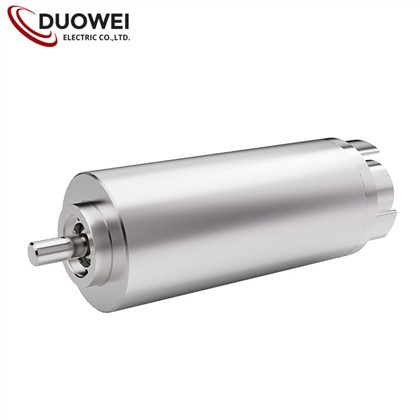


Definition of Brushless DC Motor
A brushless DC motor (BLDC) is an electric motor powered by a direct current voltage supply and commutated electronically instead of by brushes like in conventional DC motors. The advantages of a brushless motor over brushed motors are high power-to-weight ratio, high speed, nearly instantaneous control of speed (rpm) and torque, high efficiency, and low maintenance. Brushless motors find applications in such places as computer peripherals (disk drives, printers), hand-held power tools, and vehicles ranging from model aircraft to automobiles.
Working Principle of Brushless DC Motor
BLDC motor works on the principle similar to that of a Brushed DC motor. The Lorentz force law which states that whenever a current carrying conductor placed in a magnetic field it experiences a force. As a consequence of reaction force, the magnet will experience an equal and opposite force. In the BLDC motor, the current carrying conductor is stationary and the permanent magnet is moving. When the stator coils get a supply from source, it becomes electromagnet and starts producing the uniform field in the air gap. Though the source of supply is DC, switching makes to generate an AC voltage waveform with trapezoidal shape. Due to the force of interaction between electromagnet stator and permanent magnet rotor, the rotor continues to rotate. With the switching of windings as High and Low signals, corresponding winding energized as North and South poles. The permanent magnet rotor with North and South poles align with stator poles which causes the motor to rotate.

Benefits of Brushless DC Motor

Long Life and Low Noise
One problem with brushed DC motors is the wearing of the brushes and commutator, which are in constant contact. In some cases, abrasion of the brushes is also a source of dust or sparking. No such wear occurs on brushless DC motors as they lack this mechanical contact. As the absence of abrasion dust or sludge prolongs the motor life, it helps reduce the frequency of maintenance for routine motor replacement. Choosing brushless DC motors for critical equipment extends its product life and avoids motor-related defects. The characteristic scraping sound produced by brushed motors as the brushes rub against the commutator may be the result of resonance between parts or audible noise due to their rubbing against each other, sound produced by vibration or other movement in the rotor thrust direction, wind noise if the rotor has a built-in fan, or electromagnetic humming due to magnetic forces causing the stator core to vibrate.
More Reliable Speed Control than Brushed Dc Motors
As is the case for brushed DC motors, it is necessary to consider the moment of inertia of the motor shaft. Both the motor and power transfer (driveshaft) mechanisms have a moment of inertia, the size of which depends on weight, diameter, and length. Appropriate control is needed to deal with the high startup torque that occurs when the motor starts to turn, which demands a higher current than when the motor is running at a steady speed. A certain amount of energy is also lost to heat and vibration whenever the shaft is turning. In brushless DC motors, a Hall device (magnetic sensor) is used for feedback control and to determine the state of the motor. By adjusting the motor voltage, the motor speed can be kept constant despite changes in load. Precise speed control is possible with brushless DC motors.


Low Electromagnetic Noise
Brushed DC motors tend to generate noise due to the significant sparking that occurs at each switching of contact between the brushes and commutator. Noise is a form of electromagnetic energy, just like other electrical signals. In the absence of appropriate control measures, it can interfere with other devices or electronic components, causing misoperation or degraded performance. The motor current of brushless DC motors can be controlled electronically. As this tends to result in less electromagnetic noise, they are recognized as providing better conversion efficiency than brushed DC motors, with lower levels of energy loss and noise.
Potential for Energy Saving
The weight of individual parts is an important factor in reducing overall product weight. Because they do not require a brush assembly, the design of brushless DC motors is inherently more flexible, providing scope for reducing their size and weight. Furthermore, the smaller the parts of the motors, the less energy is needed to turn the motor. Given that power consumption by electric motors is estimated to account for 40 to 50% of global electricity use, a higher conversion efficiency (meaning less electricity is required to deliver a given amount of rotational energy) also helps reduce the load on the environment. The features of brushless DC motors, which include long life, ease of control, and low electromagnetic noise, are essential to ensuring reliable equipment control. They also contribute to extending the lives of appliances, personal computer peripheral equipment, and other such products. The overall impact that products have on the environment is also reduced by using motors that do not contain any lead, hexavalent chromium, or other materials restricted by environmental standards such as RoHS.

Types of Brushless DC Motor

Single-Phase BLDC Motor
BLDC commutation relies on feedback on the rotor position to decide when to energize the corresponding switches to generate the biggest torque. The easiest way to accurately detect position is to use a position sensor. The most popular position sensor device is Hall sensor. Most BLDC motors have Hall sensors embedded into the stator on the non-driving end of the motor. The permanent magnets form the rotor and are located inside the stator. A Hall position sensor (“a”) is mounted to the outside stator, which induces an output voltage proportional to the magnetic intensity (assume the sensor goes HIGH when the rotor’s North Pole passes by, and goes LOW when the rotor’s South Pole passes by).

Three-Phase BLDC Motor
A three-phase BLDC motor requires three Hall sensors to detect the rotor’s position. Based on the physical position of the Hall sensors, there are two types of output: a 60° phase shift and a 120° phase shift. Combining these three Hall sensor signals can determine the exact communation sequence. Three Hall sensors—“a,” “b,” and “c”—are mounted on the stator at 120° intervals, while the three phase windings are in a star formation. For every 60° rotation, one of the Hall sensors changes its state; it takes six steps to complete a whole electrical cycle. In synchronous mode, the phase current switching updates every 60°. For each step, there is one motor terminal driven high, another motor terminal driven low, with the third one left floating. Individual drive controls for the high and low drivers permit high drive, low drive, and floating drive at each motor terminal.

Sensorless BLDC Motor
However, sensors cannot be used in applications where the rotor is in a closed housing and requires minimal electrical entries, such as a compressor or applications where the motor is immersed in a liquid. Therefore, the BLDC sensorless driver monitors the BEMF signals instead of the position detected by Hall sensors to commutate the signal. The sensor signal changes state when the voltage polarity of the BEMF crosses from positive to negative or from negative to positive. The BEMF zero-crossings provides precise position data for commutation. The sensorless commutation can simplify the motor structure and lower the motor cost.
Applications of Brushless DC Motor
Transport
Brushless motors are found in electric vehicles, hybrid vehicles, personal transporters, and electric aircraft. Most electric bicycles use brushless motors that are sometimes built into the wheel hub itself, with the stator fixed solidly to the axle and the magnets attached to and rotating with the wheel. The same principle is applied in self-balancing scooter wheels. Most electrically powered radio-controlled models use brushless motors because of their high efficiency.
Cordless Tools
Brushless motors are found in many modern cordless tools, including some string trimmers, leaf blowers, saws (circular and reciprocating), and drills/drivers. The weight and efficiency advantages of brushless over brushed motors are more important to handheld, battery-powered tools than to large, stationary tools plugged into an AC outlet.
Heating and Ventilation
There is a trend in the heating, ventilation, and air conditioning (HVAC) and refrigeration industries to use brushless motors instead of various types of AC motors. The most significant reason to switch to a brushless motor is a reduction in power required to operate them versus a typical AC motor. In addition to the brushless motor's higher efficiency, HVAC systems, especially those featuring variable-speed or load modulation, use brushless motors to give the built-in microprocessor continuous control over cooling and airflow.
Industrial Engineering
The application of brushless DC motors within industrial engineering primarily focuses on manufacturing engineering or industrial automation design. Brushless motors are ideally suited for manufacturing applications because of their high power density, good speed-torque characteristics, high efficiency, wide speed ranges and low maintenance. The most common uses of brushless DC motors in industrial engineering are motion control, linear actuators, servomotors, actuators for industrial robots, extruder drive motors and feed drives for CNC machine tools. Brushless motors are commonly used as pump, fan and spindle drives in adjustable or variable speed applications as they are capable of developing high torque with good speed response. In addition, they can be easily automated for remote control.
Aeromodelling
Brushless motors have become a popular motor choice for model aircraft including helicopters and drones. Their favorable power-to-weight ratios and wide range of available sizes have revolutionized the market for electric-powered model flight, displacing virtually all brushed electric motors, except for low powered inexpensive often toy grade aircraft.[citation needed] They have also encouraged growth of simple, lightweight electric model aircraft, rather than the previous internal combustion engines powering larger and heavier models. The increased power-to-weight ratio of modern batteries and brushless motors allows models to ascend vertically, rather than climb gradually.
Radio-Controlled Cars
Their popularity has also risen in the radio-controlled (RC) car area. These motors provide a great amount of power to RC racers and, if paired with appropriate gearing and high-discharge lithium polymer (Li-Po) or lithium iron phosphate (LiFePO4) batteries, these cars can achieve speeds over 160 kilometres per hour (99 mph). Brushless motors are capable of producing more torque and have a faster peak rotational speed compared to nitro- or gasoline-powered engines. Nitro engines peak at around 46,800 r/min and 2.2 kilowatts (3.0 hp), while a smaller brushless motor can reach 50,000 r/min and 3.7 kilowatts (5.0 hp). Larger brushless RC motors can reach upwards of 10 kilowatts (13 hp) and 28,000 r/min to power one-fifth-scale models.
Components of Brushless DC Motor
Stator
The structure of the stator of a BLDC Motor is similar to that of an induction motor. It is made up of stacked steel laminations with axially cut slots for winding. The winding in BLDC are slightly different than that of the traditional induction motor. Generally, most BLDC motors consists of three stator windings that are connected in star or ‘Y’ fashion (without a neutral point). Additionally, based on the coil interconnections, the stator windings are further divided into Trapezoidal and Sinusoidal Motors. In a trapezoidal motor, both the drive current and the back EMF are in the shape of a trapezoid (sinusoidal shape in case of sinusoidal motors). Usually, 48 V (or less) rated motors are used in automotive and robotics (hybrid cars and robotic arms).
Rotor
The rotor part of the BLDC Motor is made up of permanent magnets (usually, rare earth alloy magnets like Neodymium (Nd), Samarium Cobalt (SmCo) and alloy of Neodymium, Ferrite and Boron (NdFeB)). Based on the application, the number of poles can vary between two and eight with North (N) and South (S) poles placed alternately. The following are three different arrangements of the poles. In the first case, the magnets are placed on the outer periphery of the rotor. The second configuration is called magnetic-embedded rotor, where rectangular permanent magnets are embedded into the core of the rotor. In the third case, the magnets are inserted into the iron core of the rotor.
Position Sensors (Hall Sensors)
Since there are no brushes in a BLDC Motor, the commutation is controlled electronically. In order to rotate the motor, the windings of the stator must be energized in a sequence and the position of the rotor (i.e. the North and South poles of the rotor) must be known to precisely energize a particular set of stator windings. A Position Sensor, which is usually a Hall Sensor (that works on the principle of Hall Effect) is generally used to detect the position of the rotor and transform it into an electrical signal. Most BLDC Motors use three Hall Sensors that are embedded into the stator to sense the rotor’s position. The output of the Hall Sensor will be either high or low depending on whether the North or South pole of the rotor passes near it. By combining the results from the three sensors, the exact sequence of energizing can be determined.
Design and Technology of Brushless DC Motor
During the brushless DC motor design phase, engineers aim to optimize the brushless motor torque. Motor torque is the amount of rotational force that a motor generates during operation. The key components involved in producing torque are the magnet, the winding, and the flux path. The higher the number of pole pairs in the magnet, the higher the amount of brushless motor torque for the same dissipated power. The copper content of the winding contributes to the power provided by the motor while the flux path guides all of the magnetic fields in the usable channel, minimizing losses. Striking the right balance is important while creating a motor with maximum brushless motor torque that does not draw a tremendous amount of power.
Brushless DC Motor Technology: Slotted & Slotless
We offer mainly two types of brushless DC motor technologies: slotted and slotless. Both of these brushless DC motors have permanent magnet rotors with 2 or 4 pole pairs. Slotted brushless DC motors have coils inserted in the slots of the stator. Due to these slots, the rotor has preferred equilibrium positions when the motor is unenergized. This resistant torque is called cogging or detent torque. Slotless brushless DC motors have a self-supporting cylindrical coil, creating no detent torque thus the rotor does not have preferred equilibrium positions. Both of these brushless DC motor technologies feature high efficiency, high speed, and hall sensors/sensorless options.
One technology uses a stator that consists of stacked steel lamination with winding placed in the slots that are axially cut along the inner periphery. This is called the BLDC motor, a slotted iron structure. The other technology uses a self-supporting cylindrical ironless coil made in the same winding technique as our ironless rotor DC motors. This is called the BLDC motor, a slotless iron structure.
Control methods of Brushless DC Motor
With rotational information provided by dedicated sensors or back EMF, BLDC control can be implemented by one of three methods: trapezoidal, sinusoidal, and field-oriented control (FOC).
01
Trapezoidal Control
Trapezoidal control is the simplest method for powering a BLDC, energizing each phase in sequence. Coils are energized in either a high or low state or can be left floating. While broadly applicable, this is often not as effective as using more advanced techniques and can produce audible noise.
02
Sinusoidal Control
Sinusoidal control energizes each BLDC coil using variable duty-cycle PWM techniques to simulate analog outputs. This allows for a much smoother transition between states, using a lookup table to determine the correct signal. Coils are often energized in a saddle pattern, rather than a pure sinusoidal output.
03
Field-Oriented Control (FOC)
Field-oriented control (FOC) works similarly to variable-output sinusoidal control, but also takes the motor’s changing winding currents into account when calculating voltage inputs. FOC can produce constant torque and speeds with low acoustic noise and is the most efficient way to drive a BLDC motor.

Maintenance Tips for Brushless DC Motor
Brushless motor has an irreplaceable role in the industrial field. It is precisely because of the outstanding role of the brushless DC motor that it also needs long-term use. After the brushless motor is overloaded, the current will be too large, which will aggravate the motor fever, burn out the motor for a long time, and even cause a fire. So we should do a good job of maintenance, so as to make it work. There are 4 tips about BLDC motor maintenance.
Overheat Protection
When the brushless DC motor runs for a long time in excess of its rated current under an overload fault, it will cause the motor to overheat and reduce insulation. The protector calculates the heat capacity of the brushless DC electric motor according to the heating characteristics of the motor and simulates the heating characteristics of the motor to protect the motor. The characteristics of overload protection correspond to different trip levels.
Blocking Protection
When the high speed brushless DC motor is starting or running, if the electric timing shaft is stuck due to excessive load or its own mechanical reasons and the fault is not removed in time, the motor will be overheated, the insulation will be reduced and the motor will be burned down. Lock-turn protection is suitable for permanent magnet DC motors starting to protect such faults. Blocking protection is applicable to protect the motor when such faults occur in the process of operation. When the current reaches the set current of action, the protector should act within the set time of action or alarm time.
Maintenance of Commutator
The commutator is a very important part of a brushless DC motor, which is also one of the main reasons for motor failure. Among them is the commutator this piece, The commutator working condition is directly related to the DC motor working condition, so must strengthen maintenance. The main fault of the commutator is the commutator spark. In order to make the motor run normally, we must keep the surface of the commutator clean and clean regularly. If the commutator surface of the 12V brushless DC motor has slight stripes or grooves. The commutator can be polished or ground, and then a clean silk cloth is used to wipe the surface of the commutator, which is conducive to forming an oxide film to protect the commutator.
Maintenance of Bearing
The maintenance and lubrication of bearings are generally determined according to the bearing speed, working temperature, working environment, etc. Generally, it is necessary to use bamboo pieces to scrape the grease inside the bearing of a small brushless DC motor, and use low pressure steam for preliminary cleaning, because there will be old oil or some other debris inside the bearing sheet for a long time. In addition, it is also necessary to check whether the bearing inner and outer rings have running rings. In addition, it is also necessary to often measure the bearing clearance of the high power brushless DC motor to check whether the bearing has cracks, rust and discolor, etc. It can also rotate the bearing of the brushless DC motor to be smooth and sound uniform, without jam phenomenon.

Factors to Consider When Selecting Brushless DC Motor
Speed and Torque
One of the most important considerations when choosing a brushless motor is its speed and torque capabilities. It is important to select a motor with enough power to complete the desired task while not overloading it.
Size
Another key factor to consider is the size of the motor, which will determine the space requirements of your application. Smaller, lighter motors are typically more efficient but may have a different torque or power output than larger motors.
Cost
As with any purchase, cost is an important factor in selecting a brushless motor. When comparing prices, consider factors such as efficiency and durability to determine which motor is the best value for your application.
Control System
Depending on the application, you may need a specific control system to operate the motor. Either analog or digital systems can control brushless motors, so make sure to select one that is compatible with your specific needs.
Environment
Consider the environment in which your motor will be operating. Different motors are designed to work in different environmental conditions, so select one that suits your application’s environment. This includes factors such as temperature, humidity, and dust levels.
Certifications


Our Factory
Changzhou Duowei Electric Co.,Ltd. was founded in 1997 and has more than 200 employees. It has developed hundreds of different product applications and established extensive strategic partnerships around the world with these products. Duowei Electric, the manufacturer of Wit Motors, our company does not use "conflict minerals", and the broad service industries include: automotive, industrial automation, robotics, household equipment, medical equipment, HVAC systems, office equipment, defense and aerospace, Electrical equipment and power tools.
Ultimate FAQ Guide to Brushless DC Motor
Q: Is a BLDC motor a stepper, AC motor, or something unique?
A: Brushless DC motors rotate in quick sequential steps, so it’s tempting to throw this rotational device into the stepper motor category. As noted earlier, the practical difference is that BLDCs are typically designed for high-speed operation, while steppers are set up for precision positioning. If you need a motor to turn at several thousand RPM, a BLDC is the proper choice versus a stepper. Given that BLDC motors combine elements of stepper and servo operation, one can rightly consider BLDCs to be an entirely unique system. With excellent speed performance and efficiency, integrated feedback, and low maintenance costs, BLDC motors are an attractive option for a variety of automation projects.
Q: Why do BLDC motors turn?
A: As their name implies, brushless DC motors do not use brushes. With brushed motors, the brushes deliver current through the commutator into the coils on the rotor. So how does a brushless motor pass current to the rotor coils? It doesn’t—because the coils are not located on the rotor. Instead, the rotor is a permanent magnet; the coils do not rotate, but are instead fixed in place on the stator. Because the coils do not move, there is no need for brushes and a commutator. With a BLDC motor, it is the permanent magnet that rotates; rotation is achieved by changing the direction of the magnetic fields generated by the surrounding stationary coils. To control the rotation, you adjust the magnitude and direction of the current into these coils.
Q: What materials are in a brushless DC motor?
A: Metals make up nearly all of the material that are inside of a BLDC motor, some of these metals are iron, copper, tin, and steel but there are also other non-metal primary materials such as silicon.
Q: What are the similarities between BLDC and DC motors?
A: Both types of motors consist of a stator with permanent magnets or electromagnetic coils on the outside and a rotor with coil windings that can be powered by direct current on the inside. When the motor is powered by direct current, a magnetic field will be created within the stator, either attracting or repelling the magnets in the rotor. This causes the rotor to start spinning. A commutator is needed to keep the rotor rotating, because the rotor would stop when it is in line with the magnetic forces in the stator. The commutator continuously switches the DC current through the windings, and thus switches the magnetic field too. This way, the rotor can keep rotating as long as the motor is powered.
Q: What are the differences between BLDC and DC motors?
A: The most prominent difference between a BLDC motor and a conventional DC motor is the type of commutator. A DC motor uses carbon brushes for this purpose. A disadvantage of these brushes is that they wear quickly. That is why BLDC motors use sensors – usually Hall sensors – to measure the position of the rotor and a circuit board that functions as a switch. The input measurements of the sensors are processed by the circuit board which it accurately times the right moment to commutate as the rotor turns.
Q: What are the running types of DC brushless motor?
A: The layout of a DC brushless motor can vary depending on whether it is in “Out runner” style or “Inrunner” style.
Outrunner – The field magnet is a drum rotor which rotates around the stator. This style is preferred for applications that require high torque and where high rpm isn’t a requirement.
In runner – The stator is a fixed drum in which the field magnet rotates. This motor is known for producing less torque than the out runner style, but is capable of spinning at very high rpm.
Outrunner – The field magnet is a drum rotor which rotates around the stator. This style is preferred for applications that require high torque and where high rpm isn’t a requirement.
In runner – The stator is a fixed drum in which the field magnet rotates. This motor is known for producing less torque than the out runner style, but is capable of spinning at very high rpm.
Q: Do brushless DC motors last longer?
A: If you are looking for a motor with a long life expectancy, consider a brushless motor. Brushed motor life is limited by the brush type and can attain 1,000 to 3,000 hours on average, while brushless motors can attain tens of thousands of hours on average, as there are no brushes to wear.
Q: Why do brushless motors go bad?
A: External factors, such as vibration and shock, can also impact the lifespan of a brushless motor. These factors can cause wear and tear on the motor, and eventually lead to failure. Debris and dust also pose a risk to the motor, as they can cause corrosion and other damage.
Q: Are brushless DC motors noisy?
A: In the brushless motor, the permanent magnet enters the air gap roughly along the radial direction, and generates radial force on the stator and rotor, thus causing electromagnetic vibration and noise.
Q: How can I reduce the noise of my brushless motor?
A: The internal balance of brushless motors can be enhanced by using specialized magnetic materials in the rotor. This material can provide higher energy density. The use of NdFeB material means that the rotor assembly can be smaller and provides better internal balance for minimal vibration.
Q: Why is my brushless motor not spinning?
A: A brushless motor should spin freely when all the wires are separated as there is not a complete circuit. If the motor resists your rotation regardless of the wire connections, it's likely that your motor has an internal short circuit.
Q: Why does the BLDC motor have three Hall sensors?
A: For the BLDC motor to rotate, the magnetic field of the stator coil and the magnetic field of the rotor’s permanent magnet should constitute certain angle. The rotor’s transmission process is a process in which the direction of the rotor’s magnetic field changes. In order to ensure certain angle between the magnetic field of the two, when the angle reaches certain value, the magnetic field direction of the stator coil should change. Then, how can one judge the necessity of changing the direction of the stator magnetic field? The three Hall sensors can help. The three Hall sensors is responsible for telling the controller when to change the current direction.
Q: Why brushless DC motor be used with speed reducer?
A: Generally, the reduction rate of a speed reducer can be as low as 3:1 or even smaller, it may also be as big as 170:1 or even larger. For example, when the speed of a brushless motor is 1300 rpm, the output speed of reducer can be as high as 450 rpm or even greater, or as low as 7.5 rpm or even smaller. Common brushless DC motors don't have such a large speed range. Even the multistage variable speed motor, the two-stage motor that has the fastest speed is about 2800-2900 rpm and the 12-stage motor that has the lowest speed is about 450-500 rpm. But if only decades of speed is required, the common brushless DC can't work. The load equipment requiring low-speed operation often requires a larger moment (such as the good ladder, up- coiler). Even the speed of brushless DC meets the requirements, its moment can't meet.
Q: How to position control the BLDC motor?
A: The greatest challenging facing BLDC motor control is not position detection and phase switching but the starting mode. Since the back electromotive force and the rotating speed of the motor winding are positively correlated, BEMF will be too small to obtain accurate detection when the rotating speed is slow. Hence, when the electric motor starts from the rotating speed of zero, the back electromotive force method is usually inapplicable. Other methods should be adopted to first active the motor to certain speed, which can help BEMF reach the level required by detection and switch to the back electromotive force method for BLDC motor control.
Q: Can brushless DC motor be used as generator?
A: The equipment can run at low speed and high power, which can save the speed reducer from directly driving large loads. Many people have doubts about whether the brushless DC motor can be used as a generator under certain conditions. Can the two be replaced with each other? The magnetism of brushless DC motor is different from that of generator, which is divided into excitation and self-excitation. There is an excitation coil to adjust the magnitude and direction of current. A rotating excitation coil exists in the form of direct current, circulating around a line resistance, and reversible current changes its current direction in the same way.
Q: How to control BLDC motor using PWM?
A: The BLDC motor has found wide applications in the field of household applications, automobile, medical care, industrial equipment, etc. Meanwhile, the three-phase BLDC motor is more popular than other BLDC motor series. Different modulation methods have a huge influence on the operation performance of the BLDC. In recent years, with refinement of the motor control system, the appearance of the sine PWM can reduce the motor pulse and alleviate the current waveform distortion, but the latter's algorithm is more complex.
Q: How to troubleshoot BLDC motor overheating?
A: Common overheating causes and treatment methods of brushless DC motor.
1. Overload. Load should be reduced or large capacity motors should be replaced.
2. Local short circuit or grounding of winding, local overheating of motor in light time, burning of insulation in serious time, emitting scorching odor or even smoking. The DC resistance of each phase of the winding should be measured, or the short-circuit point should be found, and the grounding of the winding should be checked by megohmmeter.
1. Overload. Load should be reduced or large capacity motors should be replaced.
2. Local short circuit or grounding of winding, local overheating of motor in light time, burning of insulation in serious time, emitting scorching odor or even smoking. The DC resistance of each phase of the winding should be measured, or the short-circuit point should be found, and the grounding of the winding should be checked by megohmmeter.
Q: Why does the BLDC motor need the controller?
A: Since there is no electric brush and commutator between the stator and rotor between the BLDC motor, the controller provides the direct current from different current directions to realize alternation of the current direction of the coil within the electric motor.
Q: Under which temperature can the BLDC motor work normally?
A: If the temperature of the electric motor cover is higher than the ambient temperature by more than 25°, it means that the temperature rise of the electric motor has exceeded the normal scope. Generally, the electric motor’s temperature rise should be controlled under 20°. The electric motor coil is wrapped by the enameled wire. However, the paint film of the enameled wire will drop when heating under the temperature of around 150°, thus causing the short circuit of the coil. When the coil temperature is above 150°, the BLDC motor shell will reach the temperature of around 100°. Based on the shell temperature, the BLDC motor can stand the highest temperature of 100°at most.
Q: How does the BLDC motor realizes phase shift?
A: When the brushless motor is rotating, the electrification direction of the coil within the electric motor requires alternation, thus ensuring sustainable rotation of the electric motor. The phase shift is finished by the BLDC motor.
Q: How does a brushless DC motor work?
A: Conventional DC motors use a stationary magnet with a rotating armature combining the commutation segments and brushes to provide automatic commutation. In comparison, the brushless DC motor is a reversed design: the permanent magnet is rotating whereas the windings are part of the stator and can be energized without requiring a commutator-and-brush system. The commutation of the brushless DC motor is made electronically and can be done either by looking at the back-EMF of the motor or by using a position sensor.
Q: What are the features of our BLDC motors?
A: Most of our BLDC products can be customized or modified with special features that include.
Special shafts (longer or shorter, larger or smaller diameters, cross holes, axial holes, cannulated, special materials and coatings)
Special construction for non-medical applications (aluminum housing/end bellws, steel gearhead components, steel bearings)
Special windings (higher voltage, different speeds)
Special lead terminations (no connections, special connectors, integral connectors, special colors)
Special mounting features
Alternate lam materials
Alternate magnet materials
Sterilizable option
Encoder options
Q: What are the applications of BLDC motors?
A: Brushless DC motors are integral to many applications, especially those in the Medical Device, Industrial Automation, Aerospace and Defense, Security and Access, and other industries.
MEDICAL
BLDC motors are ideal for high speed surgical and dental hand tools, including small bone and large bone tools and dental tools such as drills. They are also very effective for respirators and ventilators, infusion and insulin pumps, dental imaging, and analyzers.
INDUSTRIAL AUTOMATION
Brushless DC motors are used in industrial nut runners and screwdrivers, air pumps, conveyors, and electronic assembly devices.
AEROSPACE & DEFENSE
The longevity and reliability of BLDC motors make them a good choice for aircraft on-board instrumentation, gyroscopes, and satellites. They are also commonly used in valves, fuel metering systems and electric actuators.
SECURITY & ACCESS
The compact size and low running temperatures of Brushless DC motors make them excellent for use in barcode readers, cameras, locks, and ticket printers and dispensers.
OTHER
Other applications for brushless DC motors are robotics, precision instrumentation, and engraving.
Q: How to maintain BLDC motors?
A: Before disassembling, blow the dust on the surface of the motor .
Choose a clean working environment .
Learn the structural characteristics of the motor and the maintenance technical requirements.
Prepare the tools (including special tools) and equipment needed for disassembly.
To further understand the defects in the motor during operation, a test should be performed before disassembly . Therefore, the motor should rotate under load for detailed inspection of the temperature, sound, vibration, voltage, current, and speed should be tested. Then perform a separate no-load test to measure the no-load current and no-load loss and record the results.
Cut off the power supply, remove the external wiring of the motor, and make a record.
Use a megohmmeter with an appropriate voltage to test the insulation resistance of the motor. In order to compare the insulation resistance values measured during the previous maintenance to judge the trend of the insulation change and insulation status of the motor, the insulation resistance values measured at different temperatures should be converted to the same temperature, generally converted to 75℃.
Test the absorption ratio K. When the absorption ratio is greater than 1.33, it indicates that the motor insulation has not been dampened or the degree of dampness is not severe. In order to compare with previous data, the absorption ratio measured at any temperature should also be converted to the same temperature.
As one of the leading brushless dc motor manufacturers and suppliers in China, we warmly welcome you to wholesale high-grade brushless dc motor for sale here from our factory. All custom products made in China are with high quality and competitive price. Contact us for OEM service.
brushless motor 750w, 6kw 48v bldc motor, 4074 brushless motor