

Hey there! As a supplier of 12V DC Worm Gear Motor, I often get asked a bunch of questions about these motors. One question that pops up quite frequently is, "Can I connect multiple 12V DC worm gear motors in parallel?" Well, let's dig into this topic and find out.
First off, let's understand what connecting motors in parallel means. When you connect motors in parallel, you're essentially hooking up the positive terminals of all the motors together and the negative terminals together. This way, each motor gets the same voltage, which in our case is 12V.
Now, the short answer to the question is yes, you can connect multiple 12V DC worm gear motors in parallel. But, as with most things in the world of electronics and engineering, there are some things you need to consider.
Advantages of Connecting Motors in Parallel
One of the main advantages of connecting multiple 12V DC worm gear motors in parallel is that you can increase the overall torque output. Each motor contributes its own torque, and when they're working together, the combined torque can be quite significant. This is great if you're working on a project that requires a lot of power, like a large robotic arm or a heavy-duty conveyor belt.
Another advantage is that if one motor fails, the others can still keep running. This provides a certain level of redundancy, which can be crucial in some applications. For example, in a critical industrial process, having multiple motors in parallel can prevent a complete shutdown if one motor malfunctions.
Disadvantages and Considerations
However, there are also some potential drawbacks to connecting motors in parallel. One of the biggest issues is the current draw. When you connect motors in parallel, the total current draw from the power supply increases. Each motor will draw its own current, and if you have too many motors connected, you could overload the power supply. This can lead to overheating, reduced motor lifespan, and even damage to the power supply itself.
To avoid this, you need to make sure that your power supply can handle the total current draw of all the motors. You can calculate the total current draw by adding up the current ratings of each individual motor. For example, if each 12V DC worm gear motor has a current rating of 2 amps, and you're connecting 3 motors in parallel, the total current draw will be 6 amps. So, you'll need a power supply that can provide at least 6 amps at 12V.
Another consideration is the load distribution. Each motor should be able to handle its share of the load evenly. If one motor is carrying more of the load than the others, it can overheat and fail prematurely. To ensure even load distribution, you need to make sure that the motors are properly aligned and that the mechanical connections are secure.
Compatibility and Synchronization
It's also important to make sure that all the motors you're connecting in parallel are compatible. They should have the same voltage rating (in this case, 12V), the same speed rating, and the same torque characteristics. If the motors are not compatible, they may not work together properly, and you could end up with uneven performance or even damage to the motors.
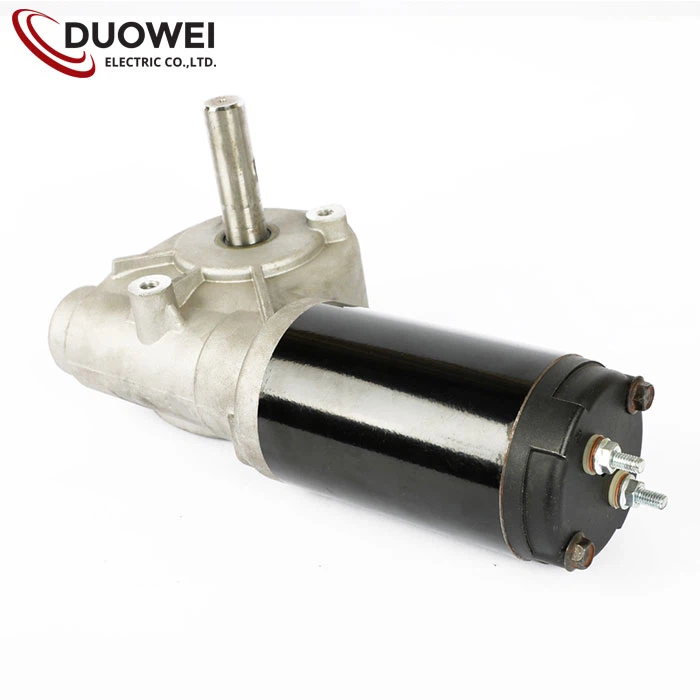

In addition, you may need to consider synchronization. In some applications, it's important that all the motors run at the same speed and in the same direction. This can be a bit tricky when connecting motors in parallel, as small differences in the motors' characteristics can cause them to run at slightly different speeds. To achieve synchronization, you may need to use additional control circuitry, such as speed controllers or encoders.
Case Studies and Examples
Let's take a look at a couple of real-world examples to illustrate these concepts. Suppose you're building a small electric vehicle, like a golf cart or a utility vehicle. You might want to use multiple 12V DC worm gear motors in parallel to increase the torque and power output. However, you'll need to make sure that your battery can handle the increased current draw. You'll also need to ensure that the motors are properly synchronized to prevent the vehicle from pulling to one side.
Another example is a large industrial mixer. In this case, you could use multiple 12V DC worm gear motors in parallel to provide the necessary torque to mix large volumes of materials. However, you'll need to carefully balance the load on each motor to prevent overheating and ensure long-term reliability.
Alternatives to Parallel Connection
If you're concerned about the current draw or the complexity of connecting motors in parallel, there are some alternatives you can consider. One option is to use a single high-torque motor instead of multiple smaller motors. This can simplify the wiring and reduce the current draw from the power supply. However, high-torque motors can be more expensive and may not be suitable for all applications.
Another option is to use a gearbox to increase the torque output of a single motor. A gearbox can provide a mechanical advantage, allowing a smaller motor to produce more torque. This can be a cost-effective solution if you don't need the redundancy or the high power output of multiple motors.
Conclusion
In conclusion, connecting multiple 12V DC worm gear motors in parallel is possible, but it requires careful consideration of the power supply, load distribution, compatibility, and synchronization. If done correctly, it can provide significant benefits in terms of increased torque output and redundancy. However, if not properly planned, it can lead to problems such as overloading the power supply and uneven performance.
If you're still unsure about whether connecting multiple motors in parallel is the right solution for your project, or if you have any other questions about our 12V DC Worm Gear Motor, don't hesitate to reach out. We're here to help you find the best motor solution for your needs. And if you're interested in exploring other types of motors, we also offer 24V PMDC Planetary Gear Motor, which can be a great option for different applications.
Whether you're a hobbyist working on a small DIY project or an engineer designing a large industrial system, we have the expertise and the products to support you. So, if you're looking to purchase high-quality motors, feel free to contact us for a quote or to discuss your specific requirements. We're ready to assist you in making the right choice for your project.
References
- "Electric Motors and Drives: Fundamentals, Types and Applications" by Austin Hughes
- "Motor Handbook" by Arnold Tustin