

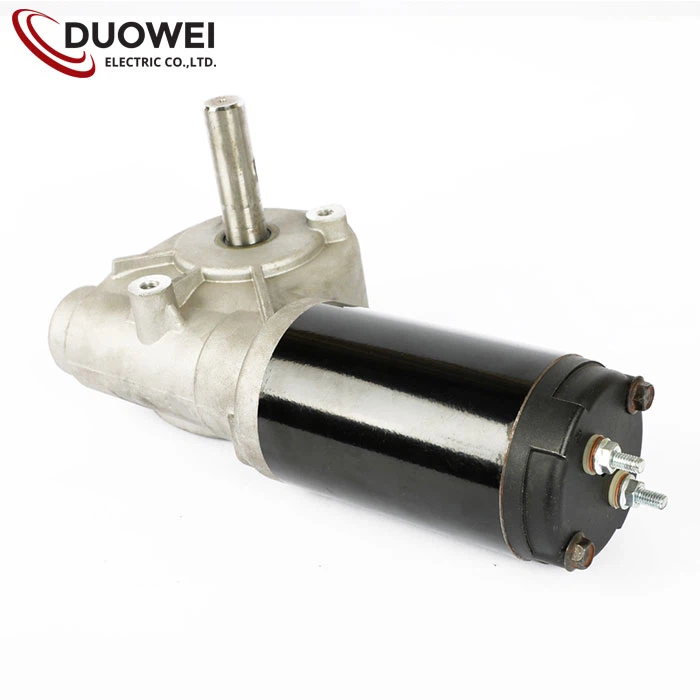
Hey there! I'm a supplier of top - notch 12V DC Worm Gear Motor. If you've got one of these motors and you're looking to install an encoder on it, you're in the right place. In this blog, I'm gonna walk you through the whole process step by step.
Why Use an Encoder with a 12V DC Worm Gear Motor?
First off, you might be wondering why you'd want to attach an encoder to your 12V DC worm gear motor. Well, an encoder is a device that provides feedback about the motor's position, speed, and direction. This feedback is super useful in applications where you need precise control. For example, in robotics, you need to know exactly how much the motor has rotated so that the robot can move accurately. In CNC machines, precise motor control ensures high - quality machining.
What You'll Need
Before we get into the installation process, let's gather all the tools and materials you'll need:
- A compatible encoder: Make sure the encoder you choose is suitable for your 12V DC worm gear motor. Check the specifications like the operating voltage, resolution, and mounting options.
- Screwdriver: You'll need it to remove and install the motor's cover and to secure the encoder in place.
- Wires and connectors: To connect the encoder to the motor and the control system.
- Mounting hardware: Depending on the encoder and the motor, you might need bolts, nuts, or brackets to mount the encoder properly.
Step 1: Prepare Your Workspace
It's always a good idea to start by preparing your workspace. Find a clean, well - lit area where you can work comfortably. Make sure the motor is turned off and disconnected from the power source. This will prevent any electrical shocks and protect both you and the equipment.
Step 2: Remove the Motor Cover
Most 12V DC worm gear motors have a cover that protects the internal components. Use your screwdriver to carefully remove the screws holding the cover in place. Set the screws aside in a safe place so you don't lose them. Once the cover is off, you'll have access to the motor shaft.
Step 3: Choose the Right Mounting Location
The next step is to decide where to mount the encoder on the motor. The encoder should be mounted in a way that it can accurately detect the rotation of the motor shaft. Usually, the best place is at the end of the motor shaft. Some encoders come with a mounting flange that can be directly attached to the motor housing, while others might require a custom - made bracket.
Step 4: Mount the Encoder
Once you've chosen the mounting location, it's time to mount the encoder. If you're using a mounting flange, align it with the holes on the motor housing and use the provided bolts to secure it. If you're using a custom bracket, make sure it's firmly attached to the motor and the encoder. Double - check that the encoder is centered on the motor shaft and that there's no wobbling.
Step 5: Connect the Encoder to the Motor Shaft
Now, you need to connect the encoder to the motor shaft. Most encoders come with a coupling that allows you to connect it to the shaft. Slide the coupling onto the motor shaft and then onto the encoder shaft. Make sure it's tightly fitted, but be careful not to overtighten it as this could damage the shaft or the encoder.

Step 6: Wiring the Encoder
Wiring the encoder is a crucial step. You'll need to connect the encoder to the power supply and the control system. First, refer to the encoder's datasheet to identify the power, ground, and signal wires. Usually, the power wire is red, the ground wire is black, and the signal wires can vary in color.
Connect the power wire to the 12V power source of the motor. Connect the ground wire to the common ground. Then, connect the signal wires to the control system. You might need to use connectors or soldering depending on the type of connection you're making. Make sure all the connections are secure and that there's no short - circuiting.
Step 7: Test the Encoder
Once you've completed the installation and wiring, it's time to test the encoder. Reconnect the motor to the power source and turn it on. Use the control system to send commands to the motor and monitor the feedback from the encoder. Check if the encoder is accurately reporting the motor's position, speed, and direction. If there are any issues, double - check your wiring and mounting.
Other Considerations
If you're interested in different types of motors, we also offer 24V PMDC Planetary Gear Motor. These motors have their own unique advantages and can be used in a variety of applications. For example, they're great for applications that require high torque and compact size.
When choosing an encoder, keep in mind that the resolution of the encoder matters. A higher - resolution encoder will provide more accurate feedback, but it might also be more expensive. You need to find a balance based on your specific application requirements.
Contact for Purchase and Consultation
If you're in the market for a 12V DC worm gear motor or any related components like encoders, I'd love to hear from you. Whether you have questions about the installation process, need help choosing the right motor for your project, or are ready to place an order, don't hesitate to reach out. We're here to provide you with the best products and support to ensure your project's success.
References
- "Motion Control Handbook"
- Manufacturer's datasheets for 12V DC worm gear motors and encoders