

Hey there! As a supplier of 12V DC worm gear motors, I often get asked about the mechanical efficiency of these motors. So, I thought I'd write a blog post to shed some light on this topic.
First off, let's talk about what mechanical efficiency means. In simple terms, mechanical efficiency is the ratio of the useful output power of a machine to the input power. For a 12V DC worm gear motor, the input power is the electrical power supplied to the motor, and the useful output power is the mechanical power delivered by the motor shaft.

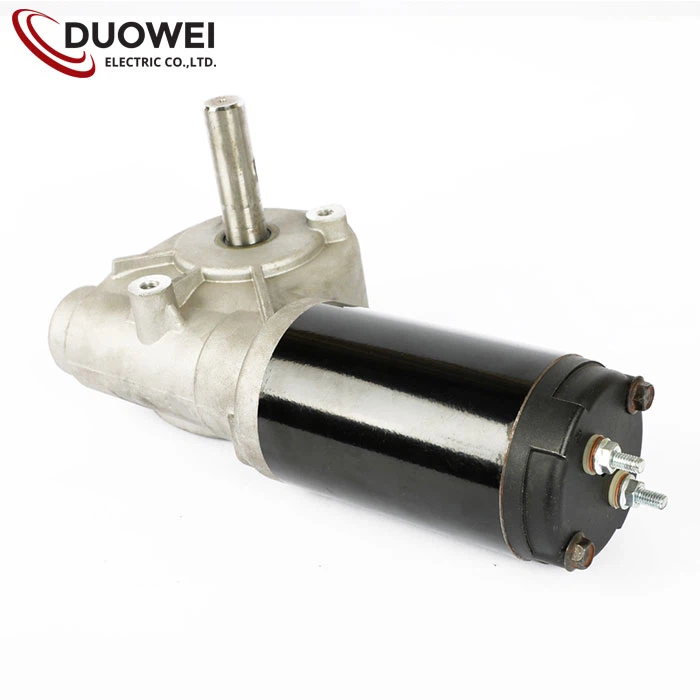
The mechanical efficiency of a 12V DC worm gear motor can vary depending on several factors. One of the main factors is the design and quality of the motor itself. High - quality motors with well - engineered gears and components tend to have higher efficiency. The materials used in the motor also play a crucial role. For example, motors with gears made from high - strength and low - friction materials will generally have better efficiency.
Another important factor is the load on the motor. When a 12V DC worm gear motor is operating under a light load, it may have a relatively high efficiency. But as the load increases, the efficiency can start to drop. This is because more power is being consumed to overcome the increased resistance, and some of the power is lost as heat due to friction in the gears and other moving parts.
The speed of the motor is also related to its efficiency. At certain speeds, a 12V DC worm gear motor may operate more efficiently. Generally, there is an optimal speed range where the motor can convert electrical energy into mechanical energy most effectively. If the motor is running too fast or too slow, the efficiency can be affected.
Let's take a closer look at how we can calculate the mechanical efficiency of a 12V DC worm gear motor. The input power (P_{in}) of a DC motor can be calculated using the formula (P_{in}=V\times I), where (V) is the voltage (in this case, 12V) and (I) is the current drawn by the motor. The output power (P_{out}) can be measured by determining the torque (T) produced by the motor shaft and the angular velocity (\omega) of the shaft. The formula for output power is (P_{out}=T\times\omega).
The mechanical efficiency (\eta) is then given by the formula (\eta=\frac{P_{out}}{P_{in}}\times100%). For example, if a 12V DC worm gear motor draws a current of 1A ((P_{in}=12V\times1A = 12W)) and produces an output power of 9W, the mechanical efficiency (\eta=\frac{9W}{12W}\times100% = 75%).
In real - world applications, the mechanical efficiency of a 12V DC worm gear motor typically ranges from about 50% to 80%. Motors with higher efficiency are more desirable because they waste less energy and can operate more economically. They also tend to generate less heat, which can extend the lifespan of the motor.
Now, you might be wondering how our 12V DC worm gear motors stack up in terms of efficiency. Well, we've put a lot of effort into the design and manufacturing process to ensure that our motors have a high level of efficiency. We use high - quality materials and advanced manufacturing techniques to reduce friction and improve the overall performance of the motors.
Our motors are also designed to be reliable and durable. They can handle a wide range of loads and speeds while maintaining a relatively high efficiency. Whether you need a motor for a small DIY project or a large - scale industrial application, our 12V DC worm gear motors are a great choice.
If you're interested in other types of gear motors, we also offer 24V PMDC Planetary Gear Motor. These motors have their own unique advantages and are suitable for different applications.
But if you specifically need a 12V DC worm gear motor, you can check out our product page 12V DC Worm Gear Motor. Here, you'll find detailed information about the specifications, performance, and features of our motors.
We understand that every customer has different requirements, and we're more than happy to work with you to find the right motor for your needs. Whether you have questions about the mechanical efficiency, the torque, or any other aspect of our motors, our technical support team is always available to assist you.
If you're thinking about making a purchase, don't hesitate to get in touch with us. We can provide you with a quote and discuss the best options for your application. We also offer excellent after - sales service to ensure that you're satisfied with your purchase.
In conclusion, the mechanical efficiency of a 12V DC worm gear motor is an important factor to consider when choosing a motor. By understanding the factors that affect efficiency and choosing a high - quality motor, you can ensure that you get the most out of your investment. So, if you're in the market for a 12V DC worm gear motor, give us a try. We're confident that you'll be impressed with the performance and efficiency of our motors.
References:
- "Electric Motors and Drives: Fundamentals, Types and Applications" by Austin Hughes
- "Motor Efficiency and Performance" - Industry research report